Why writing still matters, more than ever
In the age of autocomplete, one-line texts, and AI that will draft a paragraph for you before you finish asking, writing is easy to underestimate. But writing does something no autofill ever will. It teaches your child to think.
A reader recently wrote to the New York Times about her mother’s view on this, and it captures what we believe at Pinecone: Language is not merely how we express ourselves. It is one of the ways we become ourselves. We write in order to find out what we think. We revise in order to discover whether or not we believe it.
When a 3rd grader learns to build a sentence, they are not just learning grammar. They are learning to hold an idea long enough to shape it. When a 7th grader learns to structure a paragraph, they are learning to organize their own thinking. When a high schooler drafts and revises a college essay, they are figuring out who they are.
Writing well is one of the most consequential skills your child will ever build. And it is a skill, not a talent. It responds to instruction and practice the same way math does. That is what we are here for.
What Pinecone's writing program actually looks like
Every Pinecone writing student comes to the center twice a week for one-on-one and small-group instruction. In between sessions, they complete short daily practice at home. Not a lot. But consistent, and always at the exact level where they will be challenged without getting stuck. Vivian personally reviews each student’s work and helps with corrections and refinements, so the student leaves class with a completed assignment.
The sessions themselves follow a sequenced curriculum built by Vivian Hobbs over 30 years of teaching kids. Basic elements and strategies of writing are presented in a sequential manner in manageable pieces with lots of practice, so the student fully understands the concept before moving on.
Students typically start in second grade learning about Sentence Construction (parts of speech, verb tense, compound sentences). They then move on to Topic (choosing, sticking to, topic sentence). This leads to Supporting Details (characters, senses, the five W’s, setting). Finally, students are ready to write complete Paragraphs. Included are sections on Word Choice, Concluding Sentences, and Revising and Correcting.
What we teach, by typical age band:
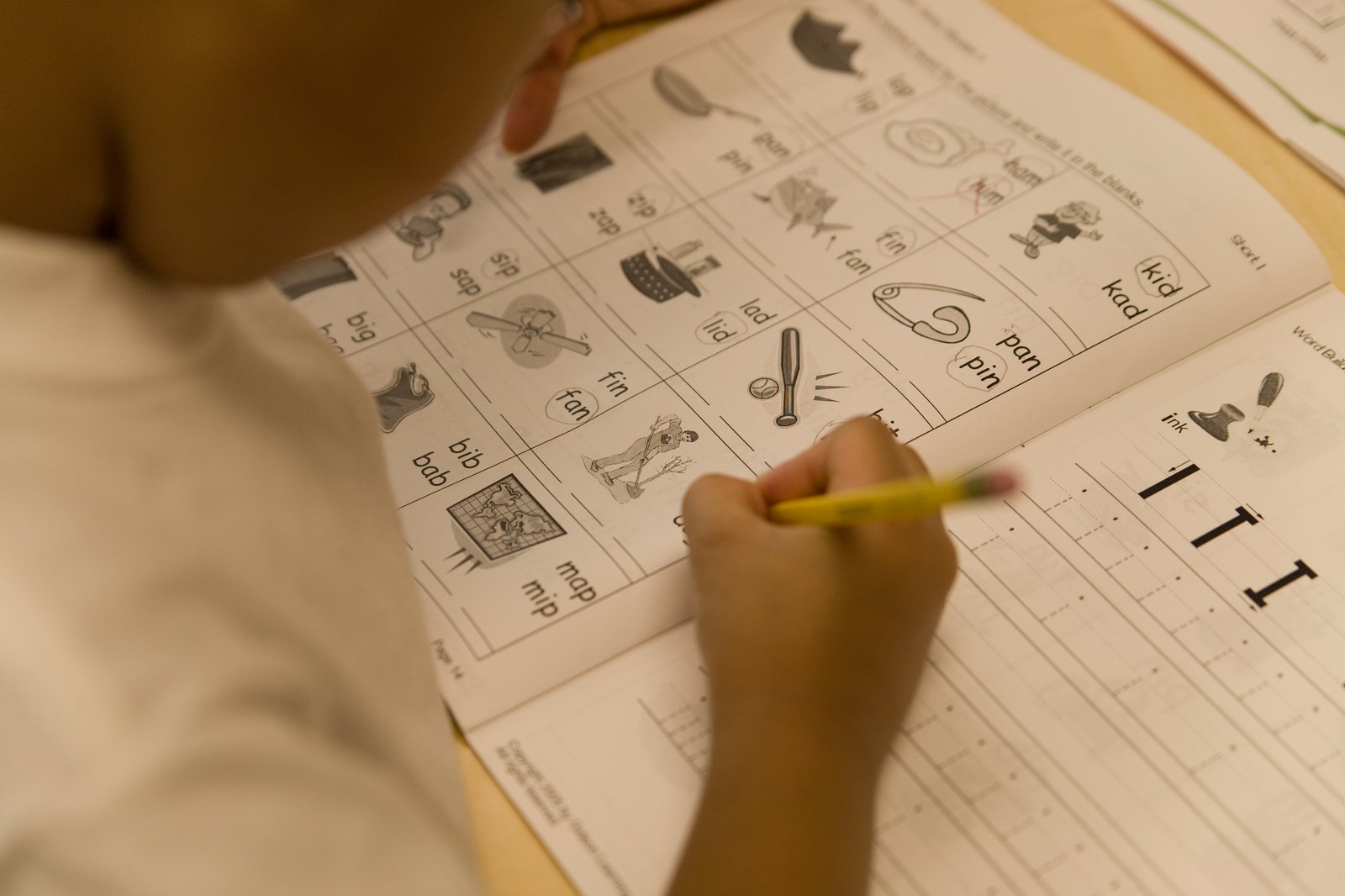
- Ages 3 to 7 (pre-K through 1st): Handwriting and letter formation. Simple word building. Foundations that make sentence work possible once the student is ready.
- 2nd and 3rd grade: Sentence construction. Vocabulary. Simple paragraph structure. Handwriting refinement.
- 4th and 5th grade: Multi-paragraph writing. Topic and supporting details. Descriptive detail. Beginning revision habits.
- Middle school (6th through 8th): Essay structure. Thesis and evidence. Argumentative and expository writing. Voice. The academic writing skills that carry through the rest of school.
- High school: Analytical essays, personal statements, and college application essays are available occasionally through private tutoring. This is not our advertised focus but Vivian works with returning families whose children have grown into it.
These bands are typical starting points, not requirements. Pinecone is ability-based, not grade-based: a 1st grader ready for topic sentences moves ahead, and a 5th grader still shaky on sentence construction fills that gap first.
Grammar is not a separate subject in the writing program. It is woven through every session, because grammar mistakes and writing weaknesses are almost always the same problem. As with the reading program, the writing program includes a dedicated grammar program that dovetails with the writing work.
The tipping point: how kids become confident writers
Malcolm Gladwell described the tipping point as "that magic moment when an idea, trend, or social behavior crosses a threshold, tips, and spreads like wildfire." Vivian uses the same phrase to describe something she has watched happen with hundreds of Pinecone students.
Most children arrive worried. Maybe their grades slipped. Maybe a teacher flagged something. Maybe a friend seems to be pulling ahead. Whatever the reason, they walk in bracing for another situation that is going to be hard.
What changes them is exactly the opposite. They get material at the right level, in the right amount, with real support. They realize they can learn something they thought was beyond them. Then something else. Then something else. Self-confidence kicks in.
It may be more of a "tipping attitude" than a "tipping point," Vivian wrote in one of her essays. But the new upward spiral is evident and obvious. It is truly a joy to watch this transition.
That is the reason most Pinecone families stay through high school. They came in for one problem and stayed for the relationship.
Why we still believe in pencil and paper
There is a reason handwriting is still central to our writing program in 2026, even when every other subject seems to be migrating to a screen.
Princeton and UCLA researchers ran a now-famous experiment showing that students who took notes by hand outperformed laptop note-takers on conceptual questions. The reason: handwriting forces the brain to rephrase ideas in the writer’s own words instead of transcribing them verbatim. Psychologists call this generative encoding, and it is one of the most powerful learning mechanisms we know.
Newer neuroscience keeps adding to the case. The fine-motor act of forming letters strengthens memory traces and comprehension. Handwriting activates premotor and frontal brain regions in ways that typing does not. Divergent thinking research even shows that students brainstorm more creatively with pen and paper than with keyboards.
For young writers still figuring out how words connect to ideas, this matters enormously. Pinecone students still write things by hand. Not because we are old-fashioned. Because it works.
How writing and reading grow together
Writing and reading are two halves of the same skill. When a student learns to write a word clearly, they have also learned to read it more confidently. When they read closely, they absorb the sentence structures they will later use in their own writing.
That is why many of our writing families also enroll in our reading program. Comprehension, vocabulary, and analysis reinforce every writing session, and vice versa. Students who work on both make faster progress on either than students who work on one in isolation.
Serving San Jose families across every neighborhood
Pinecone is at 2921 The Villages Parkway in San Jose, inside The Villages plaza. Our biggest concentration of writing students lives in Evergreen, a five minute drive from our door, followed by Silver Creek and The Villages itself. We also work with families further out in Santa Teresa and across the broader East San Jose and Aborn corridor, where our program originally opened in 2008.
Most families we work with started with one program in elementary school and stayed with Pinecone through middle school and high school as their child grew. Grammar, math, and Adventures in AI often join their program along the way.
Neighborhoods we serve
- Writing tutor in Evergreen
- Writing tutor in Silver Creek
- Writing tutor at The Villages
- Writing tutor serving Santa Teresa
- Writing tutor in East San Jose and the Aborn corridor
Frequently asked questions
- When should my child start writing tutoring?
- Most Pinecone writing students start in 2nd or 3rd grade. That is the moment school writing expectations jump from single sentences to paragraphs, and it is where a little targeted support prevents years of frustration later. Some students start earlier for handwriting or letter formation. Some start later because a teacher flagged a concern. There is no wrong time.
- How is Pinecone different from Kumon or Sylvan?
- Kumon is worksheet-driven and follows the same progression for every child. Sylvan follows a national chain playbook. Pinecone is individualized. Our writing curriculum was built by Vivian over 30 years of teaching, and it adjusts to where your child actually is rather than where a workbook assumes they should be.
- Do you help with essay writing for high school and college?
- Yes. Analytical essays, personal statements, and college application essays are core to our high school program. We also prep for the SAT and ACT writing sections. Many of our high school students started with us in 3rd or 4th grade and now come in to work on their college applications.
- How much time does the program require each week?
- Twice-weekly in-person sessions plus short daily practice at home on the other days. Roughly three hours a week total. Consistent small doses beat occasional long sessions.
- Can my child do reading with you too?
- Absolutely. Our reading program is designed as a companion to the writing program. The two skills reinforce each other, and most Pinecone families end up choosing both.
- Do you work with kids who have learning differences?
- Yes. Vivian has 30 years of experience working with children on the autism spectrum, and with kids who have ADHD, dyslexia, and other learning differences. Individualized pacing is our core method, which suits students who need a different rhythm than a classroom can offer.
- How will we know if it is working?
- You will see it in your child’s homework first : clearer sentences, better structure, less resistance to writing tasks. Then in their attitude. Vivian calls it the tipping point: the moment a worried student realizes they can actually do the thing they were afraid of. We also check in with parents regularly.
Come meet us
The best first step is a 15-minute phone call with Vivian. She will ask about your child, what you are hoping for, and whether Pinecone is a good fit. No assessment fee. No obligation.